 S&J TRADING COMPANY

Sonihull
Ultrasonic Anti-Fouling System
Ultrasonic biofouling-prevention technology, developed since 2008 and now part of the Alfa Laval Group.
Overview
2008
Pioneer in ultrasonic anti-fouling technology
100% Green
No chemicals — safe for people and marine life
Thousands
Of vessels and offshore installations worldwide
ATEX
Transducers certified for hazardous Zones 0, 1 & 2
Every Segment
Suitable for every vessel type and maritime segment
Own R&D
In-house centre, backed by leading academic partners
How It Works
Sonihull transducers emit a continuous, low-intensity ultrasonic signal that creates microscopic surface agitation — a stable, non-inertial cavitation effect. This stops the very first stage of fouling, the biofilm that barnacles and other marine growth feed on, from ever forming. The signal is harmless to materials, liquids, seals, bearings, and nearby sonar or acoustic equipment.
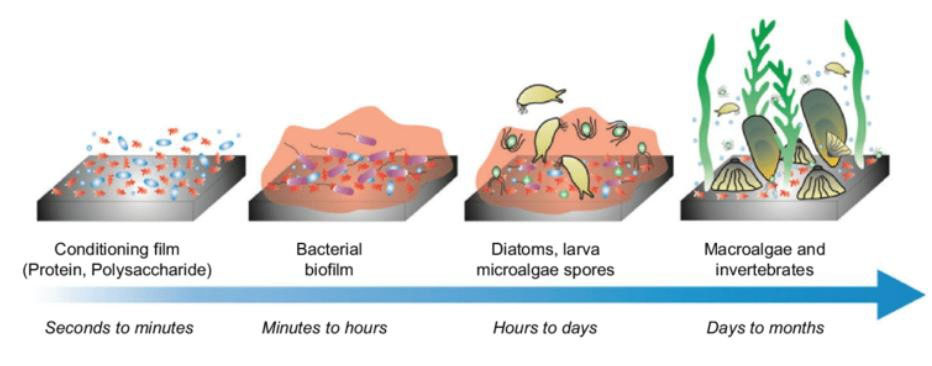
Biofouling forms in stages, from a conditioning film in minutes to macroalgae within months — Sonihull interrupts the very first stage.
Why Sonihull
Lower Fuel & GHG
Keeps the hull, propeller and seawater systems free of biofouling drag, supporting IMO CII compliance.
Near Zero Maintenance
Install once, runs continuously — no consumables, no periodic cleaning to schedule.
Retrofit-Friendly
No dry-docking or hull penetration — can be installed at anchor, minimising vessel downtime.
Reduces Invasive Species
Cleaner hulls and sea chests lower the risk of transferring species between regions.
Proven Across Industries
Marine, aquaculture, F&B, oil & gas and pharmaceuticals.
Global Support
24/7 sales and technical support network, backed by the Alfa Laval Group.
Applications
One transducer network, protecting every underwater and seawater-cooled surface on board.
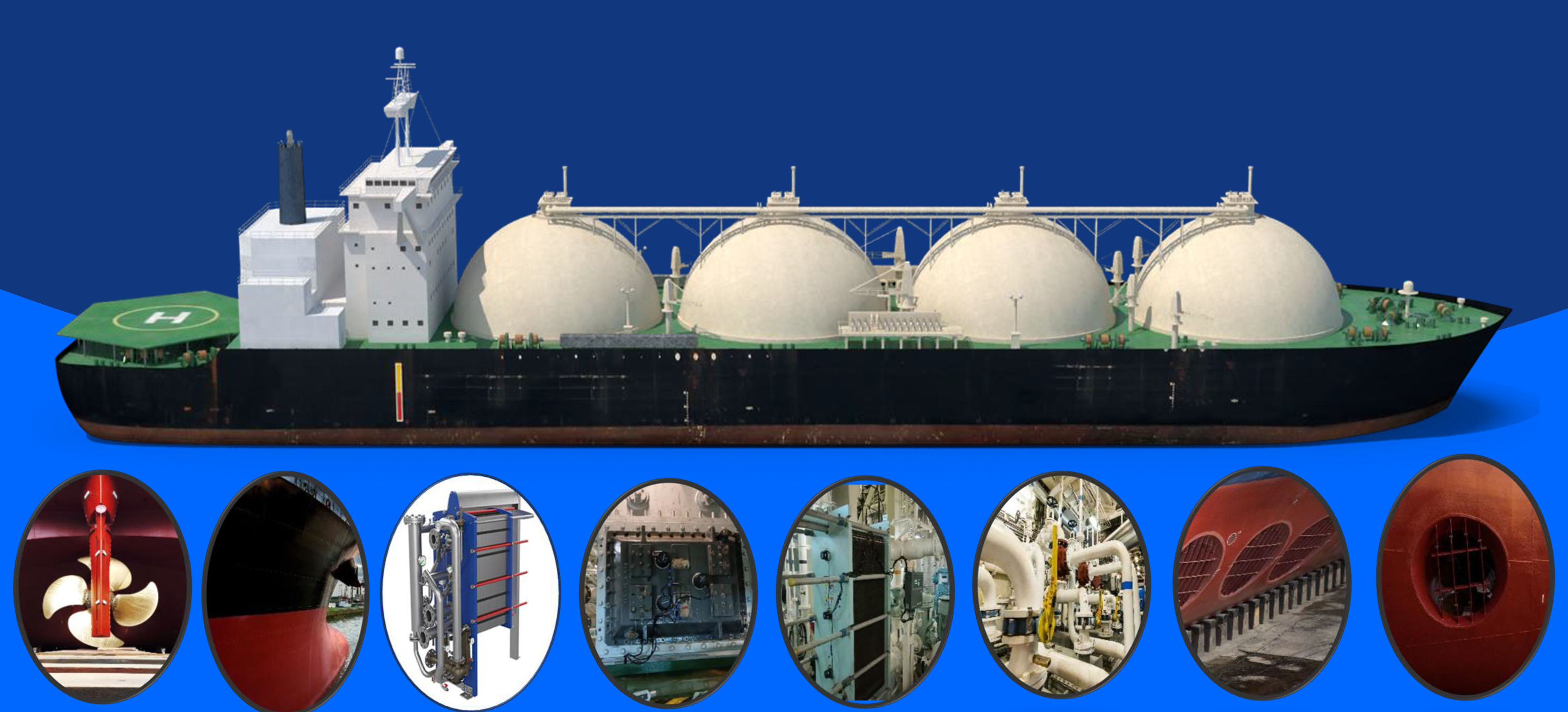
PropellerHullFreshwater GeneratorsBox CoolersPlate / Tube CoolersSeawater Cooling PipeworkSea ChestTunnel & Azimuth Thrusters
System Options
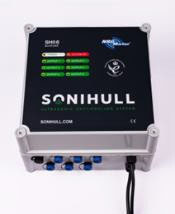
Control Panel
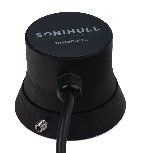
Transducer
Mounting: strapping, weldable stainless mounting ring, pipe adapter, or Versa Mount (PTFE); Ex(D) aluminium or Ex(E) stainless enclosures available for zones 0, 1 & 2.
Sonihull Xtreme
The advanced platform for larger installations.
- Scalable — one system supports up to 16 independently-operating transducers.
- Robust protection — built-in AC overvoltage, overheat and overcurrent protection.
- Modular connectivity — Bluetooth, GSM or Ethernet communication options.
- Intelligent optimisation — automatically tunes the frequency sweep and logs performance; the first system on the market with "Soniblast" and "Blastwave" technology to counter marine-life adaptation to the ultrasonic signal.
- Downloadable log — operating history can be reviewed and exported.
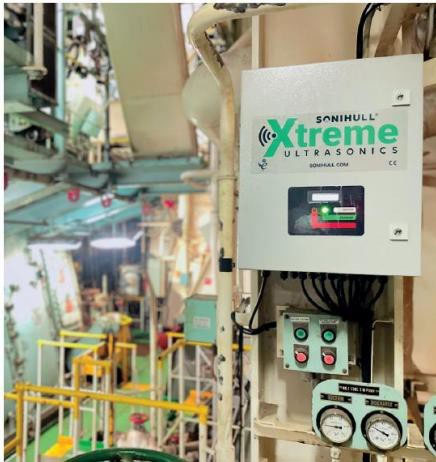
Sonihull Xtreme control panel, installed on board.
FAQ
Does it damage bearings or other machinery from vibration?
No. Sonihull's ultrasonic signal is low-intensity (about 3.6 W per transducer) and only creates microscopic surface agitation — it does not generate mechanical vibration and has no effect on bearings, shafting, or other machinery.
How long does a propeller stay clean?
Field results show at least 12 months of clean performance, including in warm-water regions where fouling normally develops fastest.
Can it replace an MGPS / ICAF or sacrificial-anode system?
No — it's complementary. MGPS/ICAF release copper/aluminium ions; cathodic anodes prevent corrosion. Sonihull uses no electrodes or consumables at all, so the systems address different problems and work well together.
Does insulated pipework reduce effectiveness?
Yes — insulation absorbs and dampens the ultrasonic signal. Transducers must be mounted on bare, uninsulated metal for the best signal transfer.
Does Sonihull interfere with sonar or acoustic positioning equipment?
No. The system is highly customisable and configured not to interfere with existing sonar equipment — important for submarines, fishing vessels, and other ships with underwater acoustic positioning.